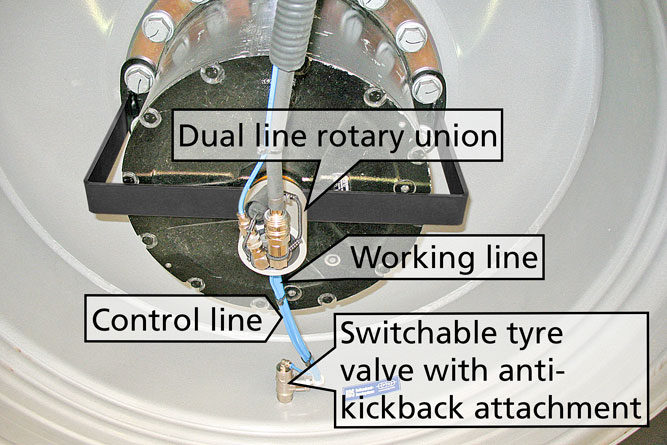
In principle, the AIRBOX/drive 2 line technology works by transferring air from a stationary component, the stator, to a rotating component, the rotor. For this process to work, pressure resilient gasket seals are installed in the stator. Together with the rotor, they form annular channels through which the air pressure flows, even while the vehicle is moving.
The rotary joint is screwed onto the wheel studs concentrically to the middle axle using a fitting stirrup. The rotor and stator are embedded and lined up with one another. Both a large line and a small control line rotate synchronously with the rotor and are led to the synchronously rotating tire valve.
In the rim, a tire valve with a non return device is installed. It immediately closes if a line tears and prevents the tire from losing pressure.
The rotary joints and the entire air line system at the front and rear axles are pressurized only during an active control cycle. The patented two line principle ensures that after every pressure change, the tire is closed off and all transfer units, including gasket seals, are depressurized. This protects the system from unnecessary wear. This technology also ensures that the tire loses no air in the event of a leak in the regulating system or a break in the line, thereby providing increased safety.
The air lines run over the fender through a telescopic tube and are led to the middle of the wheel. Using the telescopic tube, the clearance to the side of the rotating wheel can be individually adjusted.
The large line and the control line are connected to the rotary joints using quick action couplings, so they can be easily removed when not in use and placed on the fenders in empty coupling points.
Operating the AIRBOX/drive 2 line technology is done simply and comfortably using the digital control console in the cab.